
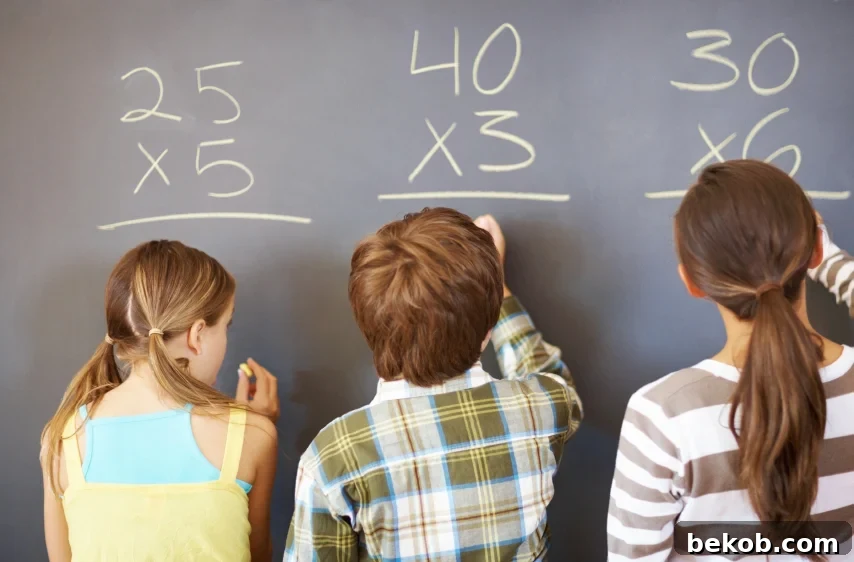
10 Engaging Hands-On Math Activities for 9-11 Year Olds: Making Learning Fun!
Is your child approaching or navigating the crucial 9-11 age range, where abstract mathematical concepts often become more prominent? This period, often spanning grades 4-6, is pivotal for building a strong foundation for future mathematical success. If you’re looking to supplement their math education and help them truly grasp challenging topics like fractions, decimals, and geometry, but aren’t sure where to begin, you’ve landed in the perfect spot!
Hands-on math activities are far more than just supplemental exercises; they are transformative learning experiences. They engage children in a multitude of ways – physically manipulating objects, verbally explaining their reasoning, aurally processing instructions, and visually comprehending abstract ideas. By playing, exploring, and sharing mathematical discoveries together, you can solidify and reinforce difficult math concepts in an enjoyable manner. This approach doesn’t just help kids tolerate math; it helps them develop a genuine love and appreciation for it, building confidence and critical thinking skills that extend far beyond the classroom. We’ve curated a list of 10 outstanding options tailored specifically for your 9-11 year old to make math an adventure, not a chore!
Dive Into Digital Worlds: Engaging Computer Math Games
In today’s digital age, online games offer a fantastic opportunity to make math interactive and appealing. They provide immediate feedback, often feature captivating graphics, and can adapt to a child’s learning pace, making complex subjects more accessible and less intimidating. These resources leverage technology to create dynamic learning environments where problem-solving feels like play.
1. Fractions and Decimals – Topmarks
Fractions and decimals are often stumbling blocks for elementary and middle school students. This Topmarks resource offers a fantastic collection of engaging games designed to demystify these critical concepts. Children can delve into activities like “Magic Math Market,” where they manage money and practice decimal calculations, “Fraction Beach,” which uses visual models to build understanding of fractional parts, or “Fraction Flags,” challenging them to identify fractions within geometric shapes. These games provide a playful environment to practice equivalence, ordering, addition, subtraction, and conversion between fractions and decimals, turning potential frustration into genuine learning.
2. Shapes, Position and Movement – Topmarks
Geometry comes alive with this collection of activities from Topmarks. Understanding shapes, spatial reasoning, and transformations (position and movement) are fundamental to higher-level mathematics. Games such as “Shapes in Space” allow children to explore 2D and 3D shapes, identifying properties like vertices, edges, and faces. “3D Exploration” encourages them to visualize objects from different perspectives, enhancing their spatial awareness. “Sorting on Venn Diagram” helps them apply logical reasoning to categorize shapes based on multiple attributes. These interactive experiences capture your child’s attention and imagination, fostering a deeper understanding of geometric principles without the need for rote memorization.
3. Interactive Tangrams – Britton Disted
Tangrams are ancient Chinese puzzles known for developing spatial reasoning, problem-solving skills, and geometric understanding. This interactive online version allows children to engage with these captivating puzzles digitally. A tangram consists of a square cut into seven specific geometric pieces (two large triangles, one medium triangle, two small triangles, one square, and one parallelogram). On this site, children can solve various puzzles by rotating, flipping, and dragging these shapes into place to form different figures and silhouettes. It’s a wonderful way to learn about congruence, area, and perimeter in an intuitive, exploratory manner, challenging their minds to think creatively about spatial relationships.
4. Online Practice Problems – Adapted Mind
While games are fantastic for conceptual understanding, focused practice is essential for mastery. Adapted Mind offers a vast library of online practice problems meticulously broken down by category and grade level. From multiplication and division to measurement, data analysis, and algebra readiness, this platform covers a comprehensive range of topics. Each problem provides immediate feedback, helping children learn from their mistakes in real-time. The structured nature of the exercises, combined with a supportive interface, makes it an excellent resource for targeted skill development and reinforcing classroom learning. It’s definitely a site worth bookmarking for consistent future use and tailored academic support.
Tangible Learning: Printables and Hands-On Resources
Beyond the screen, tangible resources like printables offer a different kind of engagement. They allow children to work offline, use pencils and paper, and physically manipulate materials, which can be crucial for kinesthetic learners. These activities provide a break from screen time while still delivering powerful educational benefits.
5. Tangram Zoo – Annenberg Learner
Building on the concept of interactive tangrams, the “Tangram Zoo” from Annenberg Learner provides printable animal figures. Instead of working digitally, children can cut out their own tangram pieces (or use existing ones) and arrange them on printed templates to create various animal shapes. This activity brings a tactile dimension to the spatial reasoning challenges of tangrams. It encourages fine motor skills, precision, and an understanding of how smaller shapes combine to form larger, more complex figures. It’s a delightful way to merge art with geometry, allowing kids to visually explore concepts of composition and decomposition in a fun, creative context.
6. Oxford Owls Activity Sheets – Oxford Owl
Oxford Owl is a treasure trove of educational resources, and their math activity sheets for 9-11 year olds are particularly valuable. Here, you’ll discover a rich assortment of printable worksheets focusing on key mathematical areas such as decimals, fractions, and place value. These sheets provide structured practice that complements online learning and classroom instruction. Children can work through problems at their own pace, reinforcing their understanding of how numbers work, the relationship between different number forms, and the significance of digit placement. The platform also conveniently links to literacy eBooks for the same age group, promoting a holistic approach to learning.
Active Engagement: Classic Games and Creative Activities
Sometimes the best way to learn is through play that doesn’t involve a screen or a worksheet. These activities leverage the power of traditional games and everyday objects to create memorable and effective math learning experiences. They encourage social interaction, strategic thinking, and the application of math concepts in relatable scenarios.
7. Fraction Cubes, Math Fact Bingo, and Dominoes – eHow Contributor, Shannon Hill
Shannon Hill’s suggestions on eHow highlight how readily available games can be repurposed for math learning. “Fraction Cubes” allows children to physically build and compare fractions, gaining a concrete understanding of abstract concepts like equivalence and addition. “Math Fact Bingo” transforms rote memorization of basic arithmetic facts into an exciting, competitive game, speeding up recall and boosting confidence. Using “Dominoes” can help kids practice addition, subtraction, multiplication, and even simple fractions, depending on how the game is adapted. These familiar games offer a comforting and fun way to practice essential math skills, proving that learning can indeed be playful and challenging at the same time.
8. Dry Erase Decimal Activity – Snaps for Fourth Grade
This innovative idea from a first-time teacher at “Snaps for Fourth Grade” provides a highly adaptable and reusable way to practice decimals. Using dry erase boards or laminated sheets, children can visualize and manipulate decimals. Activities might include representing decimals graphically, comparing decimal values, practicing addition and subtraction of decimals, or even converting them to fractions. The dry erase format allows for quick corrections and repeated practice without wasting paper, fostering a low-pressure environment for experimentation. This hands-on, interactive method helps solidify understanding of decimal place value and operations, making abstract numbers more concrete.
9. Temperature Card Game – Education.com
Understanding negative and positive integers is a crucial step in preparing for middle school math and algebra. Education.com’s “Temperature Card Game” makes learning about these concepts intuitive and engaging. Players use a set of cards representing temperature changes (positive and negative values) and a visual aid like a thermometer. As cards are drawn, children determine how the temperature rises or falls, calculating the new temperature. This game helps visualize the number line, understand the concept of zero, and grasp addition and subtraction with integers in a practical, real-world context. It’s a dynamic way to build foundational algebraic thinking.
10. M&M Math – Our Journey Westward
Who knew that a bag of candy could be such an incredible teaching tool? “M&M Math” from Our Journey Westward demonstrates the versatility of everyday objects in math education. With a simple bag of M&Ms, your child can engage in a multitude of math activities. These can include sorting and counting (data collection and graphing), calculating fractions and percentages of different colors, practicing estimation, or even creating simple probability experiments. This highly customizable activity makes math feel relevant and fun, connecting abstract concepts to a tangible, tasty treat. It’s an excellent way to see math everywhere, even in a snack!
Foster a Lifelong Love for Math
Engaging children aged 9-11 in math doesn’t have to be a struggle. By embracing these diverse hands-on activities, from interactive online games to creative printables and traditional play, you can transform how your child perceives mathematics. These resources move beyond rote memorization, encouraging critical thinking, problem-solving, and a deeper conceptual understanding.
Remember, the goal is not just to teach them answers but to foster curiosity and confidence. Whether they’re building shapes with tangrams, navigating fractions with digital tools, or exploring integers through a card game, each activity provides a unique pathway to learning. Empower your child with these fun and effective strategies, and watch as they develop a genuine enthusiasm and a strong foundation for mathematical success in the years to come. Start exploring these options today and make math a truly enjoyable journey!
Education.com has a ton of game ideas for this age range. Check them out here.
Feature image via Tutor Nerds
Kimberly Mueller is the “me” over at bugaboo, mini, mr & me, a blog that highlights her creative endeavors. She especially likes to share kid crafts, sewing attempts, recipes, upcycled projects, photography and free printable gift tags/cards. When she’s not enjoying being married to her best friend, chasing after the natives (AKA her three kids) and attempting to keep the house in one piece, you can find her with a glue gun in one hand and spray paint in the other. Aside from DIY pursuits, she also enjoys writing, reading, music, singing (mostly in the shower) and the color yellow. Kimberly recently published a craft book entitled Modern Mod Podge. You can also find her on Facebook, Pinterest, Bloglovin’ and Instagram. Email her at: bugabooblog(at)yahoo.com